
A refrigerator that hums quietly during the day can sound surprisingly loud once the house goes silent at night. The compressor starts, a fan changes speed, something vibrates against a shelf, and suddenly that background appliance is the only thing you can hear.
If refrigerator noise is keeping you awake, you have two jobs: make the sound less noticeable tonight and figure out whether the fridge is making more noise than it should.
The fastest ways to sleep through refrigerator noise are to use comfortable earplugs, create more distance between your bed and the appliance, reduce vibration, remove rattling items, and use gentle background sound if it helps you. You should also check whether the fridge is level, touching a wall or cabinet, or producing a new mechanical noise that needs attention.
Most normal refrigerator sounds are harmless. A sudden grinding, scraping, repeated clicking, or unusually loud vibration is different and should be investigated.
Quick Answer: How to Sleep Through Refrigerator Noise Tonight
If you need relief tonight, start with these simple steps:
- Move your bed or pillow farther from the refrigerator if possible.
- Try comfortable foam or reusable sleep earplugs.
- Run a quiet fan or other low-level background sound near your bed.
- Make sure the refrigerator is not touching a wall, cabinet, or nearby furniture.
- Separate bottles, jars, trays, or shelves that are rattling.
- Check whether the fridge rocks when you gently push a corner.
- Close a kitchen or bedroom door if your layout allows it.
- Move vibrating objects off the top of the refrigerator.
- Listen carefully to decide whether the sound is normal humming or something more concerning.
- Do not unplug the refrigerator overnight simply to make the room quiet.
If the appliance has suddenly become much louder, RefrigeratorSolve’s detailed guide to diagnosing a refrigerator making loud noise can help you narrow down the cause. How to Fix a Refrigerator Making Loud Noise
Can Refrigerator Noise Affect Your Sleep?
It can if the sound repeatedly wakes you, makes it difficult to fall asleep, or keeps drawing your attention whenever the compressor or fan starts.
Research on nighttime environmental noise shows a clear relationship between noise exposure and sleep disturbance. Most of that research focuses on sources such as road, rail, and aircraft noise rather than refrigerators specifically, so it would be misleading to claim that a normal refrigerator hum has the same effect. Still, an appliance close to your bed can be genuinely disruptive if you are sensitive to its cycling sounds.
The pattern of the noise can matter as much as the volume.
A steady, predictable hum may eventually fade into the background. A refrigerator that suddenly clicks, buzzes, knocks, or changes pitch every few minutes can be much harder to ignore because your brain keeps noticing the change.
That is why fixing the source of unnecessary noise is often better than simply trying to cover it up.
Why Does Your Refrigerator Sound Louder at Night?
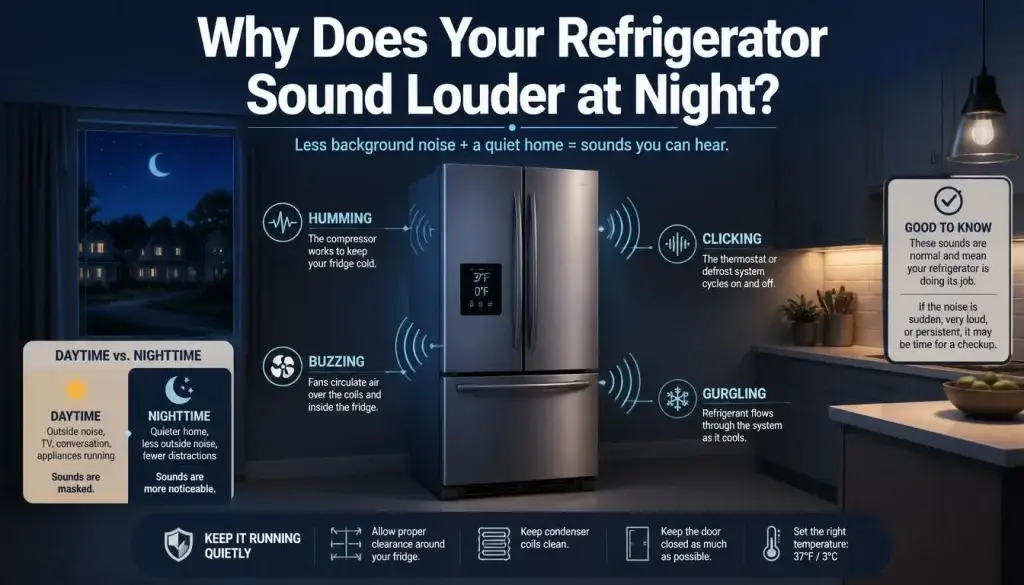
Your refrigerator does not necessarily become louder after sunset.
Your home becomes quieter.
During the day, refrigerator sounds compete with conversation, traffic, televisions, air conditioners, computers, footsteps, and general household activity. At night, those sounds disappear or become much quieter.
That leaves you noticing things such as:
- Compressor humming
- Fan airflow
- Short clicks
- Water-valve buzzing
- Ice dropping
- Refrigerant movement
- Defrost sounds
- Cabinet vibration
RefrigeratorSolve also notes that normal compressor, fan, ice-maker, and refrigerant sounds can become much more noticeable in a quiet room at night.
The important question is not simply, “Can I hear my fridge?”
Ask instead:
Is this sound new, much louder than before, harsh, or accompanied by a cooling problem?
If the answer is no, you may be dealing mainly with normal refrigerator operation that happens to be noticeable from your sleeping area.
How Loud Is Too Loud for a Refrigerator at Night?
There is no single decibel number that can tell every homeowner whether a refrigerator is “too loud.”
Sound varies between models, compressor designs, fan systems, room layouts, flooring types, installation conditions, and the distance between the refrigerator and your bed.
A better test is to compare the appliance with its own normal behaviour.
A refrigerator is less concerning when the sound is:
- A smooth, low hum
- A gentle fan noise
- A short occasional buzz
- A brief click when cooling starts or stops
- A gurgle or hiss that comes and goes
- An occasional ice-making sound
Pay more attention when the noise:
- Suddenly becomes much louder
- Changes into grinding or scraping
- Includes repeated hard clicking
- Causes strong floor or cabinet vibration
- Continues getting worse
- Comes with poor cooling
- Is accompanied by a hot or burning smell
- Starts after moving or installing the refrigerator
If you want to use a phone sound-meter app for comparison, treat the reading as a rough reference rather than a diagnostic measurement. Your phone, measurement position, room acoustics, and background noise can all affect the result.
Is Your Refrigerator Noise Normal or a Sign of a Problem?
Different sounds give you different clues.
| Sound | Often Normal? | What to Check |
|---|---|---|
| Soft humming | Yes | Compressor or fan |
| Gentle whirring | Usually | Internal fan |
| Short buzzing | Often | Water valve, ice maker, compressor |
| Light clicking | Often | Normal cycling or controls |
| Gurgling | Usually | Refrigerant or drain water |
| Brief hissing | Usually | Refrigerant or defrost operation |
| Ice dropping | Yes | Automatic ice maker |
| Rattling | Sometimes | Bottles, drain pan, wall contact |
| Strong vibration | Needs checking | Leveling, flooring, compressor vibration |
| Grinding | Usually not | Fan, motor, ice obstruction |
| Scraping | Usually not | Fan blade or moving component |
| Loud squealing | Usually not | Fan motor or bearing |
| Repeated clicking with poor cooling | Concerning | Compressor starting system |
| Heavy knocking | Needs checking | Loose part, tubing, compressor area |
If you are unsure what a new sound means, RefrigeratorSolve’s overview of what it means when a refrigerator starts making noise gives a useful sound-by-sound breakdown. What Refrigerator Noises Mean
Why Does the Refrigerator Compressor Keep Waking You Up?
The compressor helps circulate refrigerant through the cooling system. It does not necessarily run at the same speed or sound level all night.
Depending on the refrigerator, you may notice:
- A low hum when a cooling cycle begins
- A change in pitch as cooling demand changes
- Slight vibration when the compressor starts
- Longer operating periods after frequent door opening
- More runtime during warm weather
- Increased activity after adding a large amount of food
The start of a cooling cycle can be more annoying than a steady sound because it creates a noticeable change in an otherwise quiet room.
Before blaming the compressor itself, check the surrounding area. Compressor vibration can make a drain pan, water line, rear panel, wall, cabinet, or floor produce much more noise than the compressor would create on its own.
For a deeper diagnosis, see RefrigeratorSolve’s guide on how to reduce refrigerator compressor noise. Reduce Refrigerator Compressor Noise
How to Sleep Through Refrigerator Noise Tonight

You do not necessarily need to repair the refrigerator before you can get a better night’s sleep. Start with the least disruptive solutions.
1. Increase the Distance Between Your Bed and the Refrigerator
Distance is one of the simplest noise-control tools.
If you live in a studio apartment, small flat, dorm room, or other compact space, even moving the head of the bed farther from the refrigerator can make the sound less noticeable.
Try moving your sleeping position away from:
- The kitchen wall
- The refrigerator side of the room
- A shared wall that carries vibration
- The direct line between the refrigerator and your pillow
Even if you cannot move the entire bed, rotating it so your head is farther from the appliance may help.
2. Try Comfortable Earplugs
Earplugs can be particularly useful when the refrigerator produces intermittent sounds that catch your attention.
A 2026 laboratory study involving intermittent environmental noise found that foam earplugs reduced sleep disruption more effectively than pink noise under the study conditions. The research was not specifically about refrigerator noise, but it suggests that reducing sound at the ear can be more reliable than simply adding another sound to the room.
Choose earplugs designed for sleep and make sure they fit comfortably.
Do not force an earplug deeply into the ear canal, and stop using it if it causes pain or irritation.
3. Use a Quiet Fan or Gentle Background Sound
Some people find it easier to sleep when a predictable background sound makes the refrigerator’s on-and-off cycling less noticeable.
A bedside fan is a simple option because it produces a relatively consistent sound.
You can also experiment with low-level background audio. Keep the volume comfortable rather than trying to overpower the refrigerator with something louder.
More sound is not automatically better sleep.
4. Close a Door Between You and the Kitchen
If your bedroom is separate from the kitchen, closing the door can make a noticeable difference.
Check whether sound is leaking through a large gap below the door. A properly fitted door can reduce the direct path between the appliance and your sleeping area.
Do not block ventilation around the refrigerator itself.
5. Use Soft Furnishings in the Room
Hard rooms reflect sound.
A room with bare floors, empty walls, and minimal furniture can make appliance noise feel sharper.
Soft furnishings such as:
- Rugs
- Curtains
- Upholstered furniture
- Fabric wall décor
- Acoustic panels placed away from the appliance
may reduce reflections within the living space.
Do not drape blankets, foam, or acoustic material over the refrigerator.
6. Remove Anything Rattling Near the Fridge
Before going to bed, spend a minute listening closely.
Sometimes the “loud fridge” is actually:
- Two glass bottles touching
- A tray vibrating
- A loose shelf
- Something stored on top of the refrigerator
- A water line tapping the wall
- A drain pan rattling
- A nearby cabinet vibrating
Removing one small contact point can make the room significantly quieter.
Earplugs vs White Noise: Which Is Better for Refrigerator Noise?
There is no universal answer because people respond differently to sound.
Earplugs physically reduce the amount of sound reaching your ears. This can be useful when compressor starts, clicks, buzzing, or ice-making noises are waking you.
Background sound works differently. It does not remove the refrigerator noise; it makes the change between silence and refrigerator noise less noticeable.
For occasional refrigerator cycling, you could try:
- Earplugs first
- A quiet fan
- Low-level white or broadband sound
- A combination that remains comfortable
Be cautious about assuming pink noise, brown noise, or white noise automatically improves sleep. Recent controlled research found that pink noise did not perform as well as earplugs for intermittent environmental noise, and higher continuous pink-noise exposure affected sleep structure in that particular study.
Use background sound only if you personally find it calming and keep the volume modest.
How to Make Your Refrigerator Quieter at the Source
Masking the sound can help tonight. Fixing unnecessary noise is the better long-term solution.
Level the Refrigerator
A fridge that rocks slightly can transfer vibration into the floor and cabinet.
Gently press different corners.
If the appliance moves, check the adjustable leveling feet according to the owner’s manual.
The fridge should feel stable rather than wobble from side to side.
Keep It From Touching the Wall or Cabinets
Check the sides and back.
The refrigerator should not vibrate directly against:
- A wall
- Kitchen cabinets
- Baseboards
- Countertops
- Furniture
- Water lines
Maintain the clearance specified by the manufacturer for your particular model.
Rearrange Bottles, Containers, and Shelves
Glass containers can create a surprisingly loud buzz when they touch.
Separate bottles and check:
- Door bins
- Ice bins
- Glass shelves
- Trays
- Loose containers
- Items placed on top of the refrigerator
Reduce Floor Vibration
Hard flooring can transmit vibration into the room.
Make sure every refrigerator foot has firm contact with the floor.
If the appliance is correctly leveled but vibration still travels through the floor, appliance-rated anti-vibration pads may help on some installations. They must be stable and suitable for the refrigerator’s weight.
RefrigeratorSolve has a dedicated guide explaining the common causes of refrigerator vibrating noise and the checks worth making first. Fix Refrigerator Vibrating Noise
Check Accessible Condenser Areas
Dust and debris around accessible condenser components can interfere with airflow and fan operation.
Follow your refrigerator’s manual because designs vary. Some refrigerators have condenser areas that homeowners can clean, while others are more enclosed.
Unplug the refrigerator before removing an access panel or touching a fan.
Listen for Fan Noise
If the sound seems to come from inside the freezer, the evaporator fan may be involved.
A fan can become noisy because of:
- Ice touching the blade
- Debris
- A loose blade
- A damaged fan
- A worn motor
- Heavy frost around the fan area
Grinding or scraping deserves more attention than a smooth airflow sound.
If the noise clearly seems fan-related, RefrigeratorSolve’s guide to fixing fan noise in the freezer compartment explains how to narrow down the source safely. Fix Refrigerator Freezer Fan Noise
Check the Ice Maker and Water System
Some refrigerators buzz briefly when the water inlet valve opens to fill the ice maker.
That can be normal.
Investigate if the buzzing becomes unusually loud, lasts much longer than before, or happens with:
- A disconnected water supply
- A kinked line
- A restricted filter
- A malfunctioning ice maker
- Cooling or water-dispensing problems
For buzzing specifically, RefrigeratorSolve has a separate refrigerator buzzing-noise troubleshooting guide. Diagnose Refrigerator Buzzing Noise
Is Refrigerator Noise Traveling Through the Floor or Wall?
Sometimes the appliance itself is not exceptionally loud. The building is amplifying it.
This is called vibration or structure-borne sound.
A compressor creates small amounts of normal vibration. If the refrigerator touches a wall, cabinet, water pipe, hard floor, or another rigid surface, that vibration can travel through the structure.
You may notice:
- A hum that seems stronger in the bedroom than in the kitchen
- Vibration through a shared wall
- A low-frequency buzz through hardwood or laminate flooring
- Noise that changes when you lightly push the refrigerator
- A rattle that disappears when the fridge is moved slightly
Start by making sure the appliance is stable and has proper clearance.
Do not wedge blankets, cushions, or thick foam behind the refrigerator. That can restrict airflow and create a new problem.
Match the Fix to the Type of Refrigerator Noise
If you know what the sound resembles, use that as your starting point.
| What You Hear | Possible Source | First Thing to Try |
|---|---|---|
| Soft hum | Compressor | Usually observe |
| Loud hum | Compressor/vibration | Check leveling and wall contact |
| Buzzing | Water valve, ice maker, compressor | Note when it occurs |
| Rattling | Bottles, drain pan, tubing | Remove loose contact points |
| Vibration | Floor, leveling, compressor | Stabilise appliance |
| Whirring | Fan | Listen for location |
| Scraping | Fan touching ice/debris | Inspect safely |
| Grinding | Fan or motor | Investigate promptly |
| Clicking | Normal cycling/start system | Watch frequency and cooling |
| Gurgling | Refrigerant/water | Usually observe |
| Knocking | Ice maker, tubing, loose part | Locate source |
If humming is the main issue, RefrigeratorSolve’s guide on why a refrigerator makes a loud humming noise goes into more detail about compressor, fan, vibration, and airflow causes. Diagnose Loud Refrigerator Humming
How to Sleep With a Noisy Fridge in a Studio Apartment, Dorm, or Hotel

A small living space is harder because you may not have a door separating the refrigerator from your bed.
Start with the changes you can control.
In a Studio Apartment or Small Flat
Try to position your bed so your head is as far from the fridge as practical.
If furniture can be rearranged without blocking exits or appliance ventilation, use the room layout to increase separation.
A rug may help reduce some reflected and floor-transmitted sound.
In a Dorm
If the problem is a mini fridge, make sure it sits on a firm, stable surface and does not touch furniture or a wall.
Remove anything stored on top that rattles.
If the appliance belongs to the building and is making harsh mechanical noise, report it rather than dismantling it yourself.
In a Hotel
You have less control over the appliance.
If the refrigerator is unusually loud, rattling, grinding, or repeatedly disturbing your sleep, contact the front desk or maintenance team. Asking them to inspect the appliance or move you to another room is safer than modifying or unplugging hotel equipment yourself.
Should You Turn Off or Unplug a Noisy Refrigerator at Night?
Generally, no.
Unplugging the refrigerator every night is not a sensible routine solution to noise because the appliance needs to keep perishable food cold.
USDA food-safety guidance states that an unopened refrigerator will generally keep food safely cold for about four hours during a power outage. Perishable food can become unsafe when adequate refrigeration is lost for longer periods.
Instead of unplugging the refrigerator, identify why it is bothering you.
If the sound is normal, work on distance and sleep-friendly noise reduction.
If the sound is abnormal, troubleshoot or arrange repair.
The exception is when you are following a manufacturer’s specific service procedure or dealing with an electrical or mechanical safety problem where disconnecting power is necessary.
What You Should Never Do to Soundproof a Refrigerator
Some noise-reduction ideas can interfere with the refrigerator’s ability to release heat.
Avoid these shortcuts.
Don’t Wrap the Refrigerator in Blankets or Foam
Refrigerators need ventilation.
Covering the cabinet, rear area, compressor, vents, or condenser system can trap heat.
Don’t Block the Back or Bottom Ventilation
Always follow the clearance requirements in the owner’s manual.
Don’t Push the Fridge Tightly Against a Wall
That can increase vibration rather than reduce it.
Don’t Put Unstable Material Under the Feet
Loose cardboard, soft foam, folded fabric, or makeshift wedges can make the refrigerator unstable.
Don’t Take Apart the Compressor
Compressor and sealed-system work involves refrigerant, electrical components, and specialised tools. This is professional repair territory.
Don’t Ignore a Burning Smell
Unusual noise combined with overheating, smoke, a burning smell, damaged wiring, or repeated breaker trips needs prompt attention.
When Does Refrigerator Noise Need Professional Repair?
Call a qualified appliance technician when the sound is accompanied by signs that suggest more than simple vibration.
Watch for:
- Grinding that continues
- Metal scraping
- Very loud knocking from the compressor area
- Repeated clicking with little or no cooling
- A fan that is not turning
- Electrical burning smells
- Melted connectors or wiring
- Breaker trips
- Refrigerator temperatures rising
- Severe frost repeatedly reaching the fan
- A compressor repeatedly failing to start
- Noise that becomes dramatically worse in a short time
You do not need a technician for every new hum or click.
A sudden change combined with poor performance is much more significant than a familiar sound that has always been there.
When Should You Consider Replacing a Noisy Refrigerator?
Noise alone does not automatically mean the refrigerator should be replaced.
A loose tray, fan obstruction, leveling problem, or vibrating water line can be inexpensive to correct.
Replacement becomes more reasonable when several factors come together:
- The refrigerator is already old
- Cooling performance is declining
- Repairs are becoming frequent
- A major compressor or sealed-system repair is required
- Energy consumption is unusually high
- Replacement parts are difficult to obtain
- The repair cost approaches a large percentage of the replacement cost
If the refrigerator is otherwise reliable, get an accurate diagnosis before replacing it.
A Simple 5-Minute Bedtime Checklist for Refrigerator Noise
If your refrigerator is close enough to disturb your sleep, use this routine before bed:
Minute 1: Separate bottles, jars, trays, or items that may be rattling.
Minute 2: Make sure nothing on top of or beside the refrigerator is vibrating.
Minute 3: Check that the refrigerator is not touching a wall, cabinet, or loose water line.
Minute 4: Listen to the sound. Decide whether it is a normal hum or a new grinding, scraping, knocking, or repeated clicking noise.
Minute 5: Close the kitchen door if possible, put in comfortable earplugs or turn on a quiet fan, and move your sleeping position farther from the fridge.
If the sound is new or abnormal, make a note of when it happens. Knowing whether it occurs during compressor startup, ice making, fan operation, or door closing can make troubleshooting much easier the next day.
Frequently Asked Questions
Why does my refrigerator keep me awake at night?
The refrigerator may seem louder because background noise falls at night. Compressor cycling, fans, ice makers, and vibration become easier to notice in a quiet home. If the noise is new or much louder than before, check for leveling, wall contact, rattling objects, fan problems, or mechanical issues.
How can I block out refrigerator noise while sleeping?
Start with comfortable earplugs, more distance between your bed and the refrigerator, a closed door, and a quiet fan or low-level background sound. At the appliance, reduce vibration and rattling rather than trying to completely enclose the refrigerator.
Is refrigerator humming at night normal?
A smooth, low hum is usually associated with the compressor or fans and can be part of normal operation. A suddenly loud hum combined with clicking, strong vibration, overheating, or poor cooling deserves further investigation.
Why does my fridge buzz every few minutes?
A brief buzz can come from the compressor, water valve, ice maker, or another component cycling. Pay attention to exactly when it happens. If you have an ice maker, check whether the buzz lines up with water filling.
Can I soundproof my refrigerator?
You can reduce vibration and sound transmission, but you should not fully enclose the refrigerator or cover its ventilation areas. Safer options include proper leveling, adequate wall clearance, securing loose components, reducing floor vibration, and adding sound-absorbing materials elsewhere in the room.
Can I unplug my fridge overnight because it is noisy?
It is generally not recommended. Refrigerators need continuous power to keep perishable food at safe temperatures. Fix or reduce the source of the noise instead.
Why does my refrigerator sound louder when the compressor starts?
Starting the cooling cycle can create a temporary change in humming and vibration. If the refrigerator touches a wall, cabinet, water line, loose panel, or unstable floor, that normal vibration may become much louder.
Why does refrigerator noise travel through my wall?
Mechanical vibration can transfer from the appliance into rigid surfaces such as flooring, cabinets, walls, and pipes. Check refrigerator stability and make sure the appliance is not touching surrounding structures.
Is it safe to sleep near a refrigerator?
A normally operating refrigerator in a properly installed living space is generally not a problem simply because you sleep nearby. The main issue discussed here is unwanted noise. Follow the manufacturer’s installation and ventilation requirements, and investigate electrical problems, burning smells, severe overheating, or abnormal mechanical sounds.
What refrigerator noises should I worry about?
Persistent grinding, scraping, loud mechanical knocking, severe vibration, repeated failed-start clicking, or unusual noise paired with poor cooling should be checked. Burning smells or electrical symptoms require more urgent attention.
Final Thoughts
Learning how to sleep through refrigerator noise is partly about making the sound less noticeable and partly about making sure the refrigerator is not louder than it needs to be.
For tonight, start with the simplest changes: increase your distance from the appliance, use comfortable earplugs, try a quiet fan if you like background sound, close a door where possible, and remove anything that rattles.
Then deal with the source.
Make sure the fridge is level, keep it from vibrating against walls or cabinets, check loose containers and shelves, and listen for signs of fan, compressor, water-valve, or ice-maker trouble.
A low hum or occasional click can be perfectly normal. A refrigerator that suddenly starts grinding, scraping, knocking, repeatedly clicking, or struggling to cool deserves attention.
The goal is not to make a working refrigerator completely silent. It is to remove unnecessary noise so the appliance can do its job without doing yours—keeping you awake.

Hi, I’m the lead researcher and appliance enthusiast behind RefrigeratorSolve. With years of hands-on experience troubleshooting cooling systems and testing home appliances, I am dedicated to bringing you honest reviews, energy-saving tips, and practical solutions to keep your refrigerator running perfectly.