
The best way to store blueberries in the refrigerator is surprisingly simple: inspect the berries, remove any moldy or damaged ones, keep the good berries dry and unwashed, and refrigerate them promptly in their original vented container or another clean container that prevents excess moisture from building up. Wash only the amount you plan to eat.
Blueberries are delicate, and the two things that shorten their useful life fastest are trapped moisture and damaged fruit. With the right setup, fresh blueberries can stay firm, juicy, and flavorful for a week or longer instead of turning soft or fuzzy after only a few days. The U.S. Highbush Blueberry Council also recommends refrigerating fresh blueberries promptly and waiting to rinse them until you are ready to use them.
Quick answer: Sort your blueberries as soon as you bring them home, remove any soft or moldy berries, leave the rest unwashed, and place them in the refrigerator in a clean, dry container. Their original ventilated clamshell is often perfectly suitable. If condensation is a problem, add a dry paper towel to help absorb excess moisture. Keep your refrigerator at 40°F (4°C) or below and rinse the berries just before eating.
Best Way to Store Blueberries in the Refrigerator Step by Step
You do not need an elaborate produce-storage system to keep blueberries fresh. In fact, recent testing suggests that doing less can sometimes work better than complicated washing and repacking methods. The most important goals are to start with healthy berries, keep them dry, keep them cold, and avoid trapping condensation.
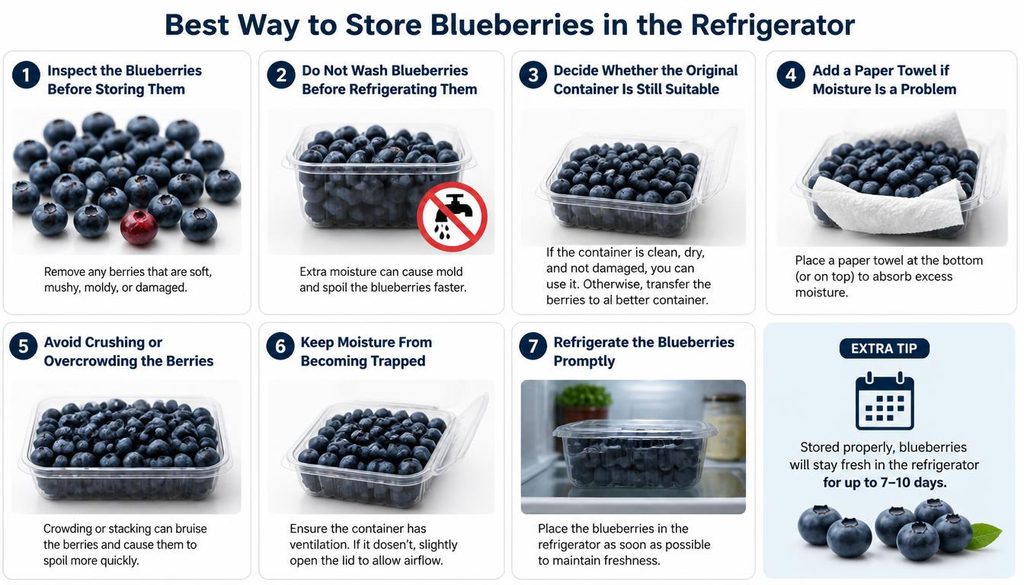
Step 1: Inspect the Blueberries Before Storing Them
Open the package and take a quick look through the berries before putting them away.
Remove blueberries that are:
- Visibly moldy
- Crushed or split
- Leaking juice
- Extremely soft
- Slimy
- Badly shriveled or damaged
You do not need to handle every berry individually. A quick inspection is usually enough.
Pay particular attention to the bottom of a store-bought clamshell. Moisture and damaged berries often collect there, especially if the package has been transported for a while.
This small step matters because spoiled fruit creates a damp environment around healthy berries and makes it easier for mold to spread.
Step 2: Do Not Wash Blueberries Before Refrigerating Them
For routine refrigerator storage, leave blueberries unwashed.
Water left on the surface of the berries can create the damp conditions that mold loves. Even if the berries look dry after a quick rinse, moisture can remain around the stem end or become trapped between berries.
The easiest routine is:
- Store them unwashed.
- Take out only the amount you want to eat.
- Rinse those berries under cool running water.
- Drain or gently dry them before serving.
The U.S. Highbush Blueberry Council specifically recommends rinsing fresh blueberries immediately before use rather than before storage.
If you regularly store several kinds of produce, the Refrigerator Solve guide on how to keep fruits fresh in the refrigerator also explains why moisture control and proper airflow make such a difference for berries and other delicate fruits.
Step 3: Decide Whether the Original Container Is Still Suitable
If your blueberries came in a clean, dry, ventilated plastic clamshell, you usually do not need to transfer them.
Those small openings allow some air circulation while protecting the berries from being crushed.
A 2026 Serious Eats test compared 18 different blueberry-storage methods and found that unwashed blueberries kept in their original packaging in the refrigerator performed particularly well.
However, transfer the berries to another clean container if:
- The original package is wet
- Juice has collected at the bottom
- The cardboard container is damp
- The berries are packed too tightly
- Several berries have already spoiled
A shallow container is usually better than a deep one because the berries at the bottom carry less weight.
Step 4: Add a Paper Towel if Moisture Is a Problem
A paper towel is helpful, but it is not mandatory.
If you frequently notice condensation in berry containers, place a clean, dry paper towel along the bottom before adding the blueberries. It can absorb small amounts of excess moisture before that moisture settles around the fruit.
Replace the paper towel if it becomes noticeably damp.
Do not tightly wrap the blueberries in paper towels. The goal is moisture control, not insulation.
If your original clamshell stays dry and the berries are in good condition, leaving them in that package without a paper towel can work perfectly well.
Step 5: Avoid Crushing or Overcrowding the Berries
Blueberries look sturdy compared with raspberries, but they still bruise easily.
Avoid pressing extra berries into an already full container. A shallow, loose arrangement helps prevent the lower berries from being crushed.
You also want enough room for cold air to circulate around the container.
If you bought several pints or punnets at once, storing them in two containers may be better than packing everything into one.
Step 6: Keep Moisture From Becoming Trapped
This is where blueberry storage advice sometimes becomes confusing.
Some storage guides recommend breathable or vented containers. Others report good results with dry blueberries stored in paper-towel-lined covered or airtight containers. Both approaches can work under the right conditions.
The practical rule is simpler:
Whatever container you use, do not let the blueberries sit in trapped moisture.
If you open the refrigerator and notice droplets on the lid or wet berries:
- Remove the berries
- Dry the container
- Replace any damp paper towel
- Make sure the fruit itself is dry
- Increase ventilation if condensation keeps returning
For most households, the original vented clamshell is the easiest low-maintenance choice.
Step 7: Refrigerate the Blueberries Promptly
Do not leave fresh blueberries sitting on the kitchen counter for hours if you plan to store them.
Place them in the refrigerator after returning from the grocery store, farmers market, delivery, or pick-your-own farm.
Keep the refrigerator at 40°F (4°C) or below. The FDA recommends this maximum refrigerator temperature for safe cold food storage.
If you are unsure whether different parts of your refrigerator are equally cold, Refrigerator Solve’s guide to the ideal fridge layout for food safety explains why food placement and temperature stability matter.
How to Keep Blueberries Fresh Longer in the Refrigerator
Freshness starts before the berries ever reach your refrigerator.
When shopping, look for blueberries that are:
- Firm
- Dry
- Plump
- Smooth-skinned
- Deep blue or blue-black
- Free of leaking juice or visible mold
A natural pale or silvery coating is normal and does not mean the blueberries are dirty.
Once you get them home, follow a few simple habits:
Refrigerate them quickly. The sooner the berries are chilled, the better.
Keep them dry. Moisture is one of the most common causes of early spoilage.
Remove damaged berries. Do not allow one leaking berry to sit underneath the rest.
Avoid unnecessary handling. Constantly transferring and touching delicate berries can bruise them.
Check the package every few days. If one berry starts leaking or molding, remove it before the problem becomes larger.
Use older berries first. If you have multiple packages, move the oldest one to the front.
These habits are more useful than relying on a single storage “hack.”
Can You Keep Blueberries Fresh for 2 Weeks?
Sometimes.
Properly refrigerated blueberries may remain usable for around one to two weeks, but there is no guaranteed two-week shelf life.
The condition of the fruit when you purchased it makes a huge difference. Blueberries that were harvested recently and handled carefully may last much longer than berries that have already spent several days in shipping, storage, and supermarket displays.
The U.S. Highbush Blueberry Council suggests using fresh blueberries within roughly 7 to 10 days, while USDA SNAP-Ed information notes that refrigerated blueberries can keep for up to about two weeks for best flavor.
Think of two weeks as a possible upper range, not a promise.
For a broader look at why refrigerated foods have different storage windows, see Refrigerator Solve’s guide to the shelf life of refrigerated foods.
Do Blueberries Need to Be Refrigerated?
Yes, if you are not eating them right away.
Fresh blueberries keep their quality much longer in the refrigerator than they do sitting at room temperature.
If you put out a bowl for breakfast or a snack, there is no need to worry about a short period on the table. But for storage, return unused berries to the refrigerator rather than leaving them out for the rest of the day.
Warm kitchens make this especially important. A summer kitchen in Florida, Queensland, or another warm climate can be very different from a cool room in Canada or the UK.
Regardless of local climate, refrigeration gives you more consistent conditions.
Should You Wash Blueberries Before Storing Them?
Usually, no.
Washing blueberries before refrigeration adds moisture, and moisture can shorten storage life if the berries are not dried extremely well.
For the simplest and most reliable routine, store them unwashed and rinse immediately before eating.
What Is the White Coating on Blueberries?
That dusty, silvery-white coating is often completely normal.
It is called bloom, a natural waxy coating on the surface of blueberries. Fresh berries can have quite a noticeable bloom.
Bloom is different from mold.
Natural bloom usually looks:
- Smooth
- Powdery
- Evenly spread across the skin
Mold is more likely to look:
- Fuzzy
- Cotton-like
- Irregular
- Concentrated around one area
- White, grey, or sometimes greenish
Do not throw away healthy blueberries simply because they have their natural bloom.
Is a Vinegar Wash Necessary?
No.
Vinegar rinses are popular online, and some people use them successfully, but they are not necessary for routine blueberry storage.
For everyday handling, the FDA recommends washing fresh produce under running water before eating or preparing it. Soap and detergent should not be used on produce.
If your main goal is maximum refrigerator life, the simplest approach remains: keep the blueberries dry and wash them shortly before eating.
How to Store Blueberries After Washing

Maybe you washed the entire package by accident. Or perhaps preparing them in advance is more convenient for your household.
You can still refrigerate washed blueberries, but drying becomes especially important.
Follow these steps:
- Place the blueberries in a colander.
- Let as much water drain away as possible.
- Spread the berries over clean paper towels or a clean kitchen towel.
- Let them dry thoroughly.
- Gently blot any visible droplets.
- Place them in a clean container lined with a dry paper towel.
- Refrigerate immediately.
- Check frequently for condensation.
Do not seal visibly wet blueberries inside a container.
Washed berries may not last as long as berries that remained dry from the beginning, so plan to use them sooner.
Is It Better to Store Blueberries in the Original Container or an Airtight Container?
There is no need to replace a dry, clean clamshell simply because another container looks more sophisticated.
Original Vented Clamshell
For most store-bought blueberries, this is the easiest choice.
Advantages include:
- Built-in ventilation
- Less unnecessary handling
- Protection from crushing
- Easy visibility
- No extra container to wash
Recent side-by-side testing also supports leaving unwashed blueberries in their original packaging when that package is clean and dry.
Airtight Container
An airtight container can work when the blueberries and container are completely dry.
The problem begins when moisture is trapped inside.
If you choose this method, lining the container with a dry paper towel and checking for condensation becomes more important.
Breathable Produce Container
A ventilated produce keeper can also work well, especially if the original packaging is damaged.
Look for a container that:
- Protects the fruit
- Does not squeeze the berries
- Allows some airflow
- Does not collect water at the bottom
Which One Should You Choose?
For simplicity, start with the original dry, vented package.
Change containers only if the original packaging is wet, damaged, overcrowded, or poorly ventilated.
There is little reason to create extra work when the berries are already packaged in a container that is doing its job.
What Is the Best Container for Storing Blueberries?
| Container | Best Use | Advantage | Watch Out For |
|---|---|---|---|
| Original vented clamshell | Everyday storage | Easy and ventilated | Check the bottom for moisture |
| Vented produce container | Replacing damaged packaging | Good airflow | Do not overcrowd |
| Shallow bowl or container | Small quantities | Less crushing | Needs suitable covering |
| Airtight container with paper towel | Completely dry berries | Limits dehydration | Condensation can become trapped |
| Sealed plastic bag | Generally not ideal | Convenient | Easily traps moisture and crushes berries |
The best container is not necessarily the most expensive one. A clean, dry environment and sensible moisture control matter more.
Where Should You Store Blueberries in the Refrigerator?
A regular refrigerator shelf is a good default location, especially if your crisper drawer tends to become damp.
The main compartment usually gives berries good access to circulating cold air.
Avoid the refrigerator door when possible. Every time the door opens, foods stored there are exposed to larger temperature changes.
Also keep fresh blueberries separated from raw meat, poultry, and seafood to reduce the risk of cross-contamination. FDA produce-safety guidance recommends keeping produce that will be eaten raw separate from these foods.
Should Blueberries Go in the Crisper Drawer?
They can, but the answer depends on your refrigerator.
Crisper drawers control humidity differently from open shelves. Some refrigerators maintain berries well in a humidity-controlled drawer; others develop enough condensation that delicate fruit becomes damp.
If your crisper has adjustable humidity, monitor the berries rather than assuming one setting is perfect for every appliance.
Refrigerator Solve’s guide to ideal humidity settings for fridge drawers lists berries among produce that can benefit from higher-humidity storage, while its broader fruit-storage guidance also emphasizes keeping berries dry and well ventilated.
That apparent difference is a useful reminder: humidity can reduce moisture loss, but visible moisture sitting on berries is still undesirable.
If berries repeatedly become wet in your crisper drawer, move them to a refrigerator shelf.
Should Blueberries Be Stored on the Refrigerator Door?
It is better to use a main shelf.
The refrigerator door is convenient, but its temperature changes more often because it is repeatedly exposed to room air.
Reserve door storage for foods that tolerate those fluctuations better.
Blueberries benefit from a consistently cool environment, so a shelf inside the main compartment is usually the safer choice.
What Is the Best Refrigerator Temperature for Blueberries?
Keep your refrigerator at 40°F (4°C) or below.
For households in the USA, Fahrenheit is usually displayed on appliance controls. Refrigerators in the UK, Canada, and Australia may use Celsius, so the same limit is approximately 4°C.
Using a refrigerator thermometer is useful if you suspect your appliance is running warm.
A fridge that feels cold is not necessarily at the correct temperature.
How Long Do Blueberries Last in the Refrigerator?
There is no single expiration date for fresh blueberries.
As a practical guide:
| Storage Condition | Typical Result |
|---|---|
| Fresh, dry blueberries stored correctly | Often about 7–10 days |
| Very fresh berries under good conditions | May approach 2 weeks |
| Washed but thoroughly dried berries | Usually best used sooner |
| Wet, leaking, or damaged berries | Can spoil much faster |
| Properly frozen blueberries | Best quality for up to about 10 months |
Starting quality matters enormously.
A package purchased near the beginning of its storage life can outlast a package that looked fine in the store but was already several days old.
Always judge the berries themselves rather than relying only on the number of days.
How to Store Fresh-Picked Blueberries in the Refrigerator
Fresh-picked blueberries may have an advantage because they have not spent days moving through a distribution chain, but they still need careful handling.
After picking:
- Remove leaves, stems, insects, and obvious debris.
- Sort out crushed or damaged fruit.
- Make sure the berries are dry.
- Do not wash them just for storage.
- Place them in a shallow, clean container.
- Refrigerate promptly.
- Wash immediately before eating.
If berries were picked while wet from rain or heavy dew, allow the surface moisture to dry before packing them tightly together.
Store-Bought vs. Fresh-Picked Blueberries
The storage principles are almost identical, but the inspection process is slightly different.
With store-bought blueberries, check:
- The bottom of the clamshell
- Condensation inside the package
- Juice stains
- Crushed berries hidden underneath
- Visible mold around stem ends
With fresh-picked blueberries, check:
- Field moisture
- Leaves or plant debris
- Overripe berries
- Split fruit
- Insects
- Berries damaged during picking
In both cases, dry, healthy fruit should go into the refrigerator as soon as practical.
How to Keep Blueberries From Getting Moldy
Mold prevention is mostly moisture management.
To reduce the chance of mold:
- Remove moldy berries as soon as you see them.
- Store blueberries dry.
- Avoid washing the entire batch before storage.
- Do not leave leaking fruit in the package.
- Replace wet paper towels.
- Keep containers clean.
- Avoid excessive crowding.
- Check for condensation.
- Keep the refrigerator properly cold.
- Do not forget berries at the back of the fridge for weeks.
There is no storage technique that guarantees mold will never appear. Blueberries are fresh produce, and eventually they deteriorate.
The goal is to slow that process without sacrificing texture and flavor.
How to Tell if Blueberries Have Gone Bad
A slightly soft blueberry is not automatically spoiled.
Look at the overall condition of the fruit.
Visible Mold
Fuzzy white, grey, or green growth is a clear sign that the affected berry should be discarded.
Do not confuse fuzzy mold with the smooth, dusty natural bloom found on healthy blueberries.
Mushy or Slimy Texture
A blueberry that collapses easily, feels slimy, or has turned into pulp is past its best.
Leaking Juice
A few split berries can create a pool of purple juice at the bottom of the container.
Remove them and clean or replace the container if necessary.
Sour or Fermented Smell
Fresh blueberries have a mild fruity smell.
A noticeably sour, fermented, alcoholic, or otherwise unpleasant odor suggests deterioration.
Wrinkled Blueberries
Wrinkled berries are not always spoiled.
If they are simply a little dehydrated but have no mold, slime, or bad smell, they can still be useful in:
- Smoothies
- Pancakes
- Muffins
- Oatmeal
- Sauces
- Compotes
- Baking
Use common sense and discard fruit showing clear signs of spoilage.
What Should You Do if One Blueberry Is Moldy?
Do not automatically throw away an otherwise healthy package because you found one bad berry.
Remove the visibly moldy berry along with berries that were directly touching it. Then inspect the rest carefully.
According to Mayo Clinic guidance, a small number of moldy berries does not necessarily mean the entire package must be discarded, provided the remaining fruit looks healthy, firm, and free of visible mold. If mold is widespread through the package, throwing out the batch is the better choice.
After removing the affected berries, keep the remaining fruit dry until you are ready to eat it, then wash it thoroughly.
Common Blueberry Storage Mistakes
Even good blueberries can spoil quickly when stored poorly.
Washing Them and Putting Them Away Wet
This is probably the most common mistake.
If you wash blueberries ahead of time, they need to be thoroughly dried.
Ignoring One Bad Berry
A leaking or moldy berry hidden at the bottom should not stay there for another week.
Check the package when you bring it home.
Assuming an Airtight Container Is Always Better
A tight seal is only useful when you are not trapping excess water with the fruit.
Condensation is the warning sign to watch.
Overcrowding the Container
Too much weight can crush berries near the bottom and create pockets of moisture.
Storing Them on the Refrigerator Door
A stable refrigerator shelf is a better location.
Ignoring a Wet Paper Towel
A paper towel that has already absorbed moisture cannot keep doing its job indefinitely.
Replace it when necessary.
Using Soap or Detergent to Wash Blueberries
Do not wash fresh produce with household soap or detergent. Rinse blueberries with clean running water instead.
Forgetting About Them
The best storage setup does not help much if the blueberries disappear behind leftovers for three weeks.
Keep delicate produce where you can see it.
When Should You Freeze Blueberries Instead?
If you already know you will not finish the berries while they are fresh, freezing is usually smarter than waiting for them to deteriorate.
Freezing works particularly well for blueberries because frozen berries are useful in smoothies, muffins, oatmeal, sauces, pancakes, and baking.
How to Freeze Blueberries
- Sort the berries and discard damaged fruit.
- Rinse them if desired.
- Dry them thoroughly.
- Spread them in a single layer on a tray.
- Freeze until firm.
- Transfer them to a freezer-safe bag or container.
- Remove excess air.
- Label the container with the date.
The U.S. Highbush Blueberry Council recommends using frozen blueberries within about 10 months for best results.
Freezing may soften the texture after thawing, so thawed blueberries are often better for cooking and blending than for eating as a firm fresh snack.
Frequently Asked Questions
Should fresh blueberries be refrigerated immediately?
Yes. If you are not eating them right away, put fresh blueberries in the refrigerator soon after bringing them home. Prompt refrigeration helps preserve their texture and quality.
Can I store blueberries in their original container?
Yes. If the original clamshell is clean, dry, and ventilated, it is often one of the easiest ways to store blueberries. Remove any damaged berries before refrigerating the package.
Should blueberries be stored in an airtight container?
They can be, but only if the berries and container are completely dry. An airtight container that traps condensation can create a damp environment. A vented original container is a simpler default option for most people.
Can you store blueberries in a Mason jar?
Yes, provided the berries are completely dry and the jar is clean. However, a Mason jar is not automatically better than the original package. Watch carefully for condensation inside the glass.
Can you store blueberries without a paper towel?
Absolutely. A paper towel is optional. If your blueberries are dry and the original ventilated package does not collect moisture, you can refrigerate them without one.
How long do washed blueberries last in the fridge?
It depends on how thoroughly they were dried and how fresh they were to begin with. Washed blueberries generally deserve closer monitoring because residual moisture can speed spoilage. Use them sooner rather than planning on the longest possible storage time.
Should blueberries be stored in the crisper drawer?
They can be, especially in a well-controlled refrigerator, but a main shelf is often easier if your crisper becomes damp. If you notice condensation or wet fruit in the drawer, move the berries to a shelf.
Why do my blueberries get moldy so quickly?
Common causes include berries that were already old or damaged when purchased, washing before storage, trapped condensation, wet packaging, poor refrigerator temperature, and leaving moldy fruit in contact with healthy berries.
Can blueberries stay out overnight?
For best freshness, refrigerate blueberries rather than routinely leaving them out overnight. They last longer under consistent refrigeration, especially in a warm kitchen.
Do blueberries ripen after picking?
Blueberries should be harvested when ripe. Unlike fruits that continue to develop significantly after harvest, blueberries will not turn properly ripe simply because they sit on your counter. Choose ripe, blue fruit from the beginning.
What is the white powder on fresh blueberries?
It is usually the blueberry’s natural waxy bloom. Bloom tends to look smooth and dusty, while mold is typically fuzzy, irregular, and concentrated in patches.
Can I freeze blueberries after they have been refrigerated?
Yes. If the berries are still in good condition, you can freeze them before they begin to spoil. Freezing is a useful option when you realize you will not finish a package in time.
Final Thoughts
The best way to store blueberries in the refrigerator is not complicated. Start by removing damaged or moldy fruit, keep the remaining berries dry and unwashed, and refrigerate them promptly in their original vented package or another clean container that does not trap excess moisture. Keep your refrigerator at 40°F (4°C) or below, monitor the berries for condensation, and rinse only the portion you are about to eat.
A dry paper towel can help when moisture is a recurring problem, but it is not a requirement. Likewise, there is no need to transfer perfectly good blueberries into a special container simply because a storage hack says you should. Fresh berries, consistent refrigeration, minimal moisture, and a quick check every few days are the habits that make the biggest difference.

Hi, I’m the lead researcher and appliance enthusiast behind RefrigeratorSolve. With years of hands-on experience troubleshooting cooling systems and testing home appliances, I am dedicated to bringing you honest reviews, energy-saving tips, and practical solutions to keep your refrigerator running perfectly.