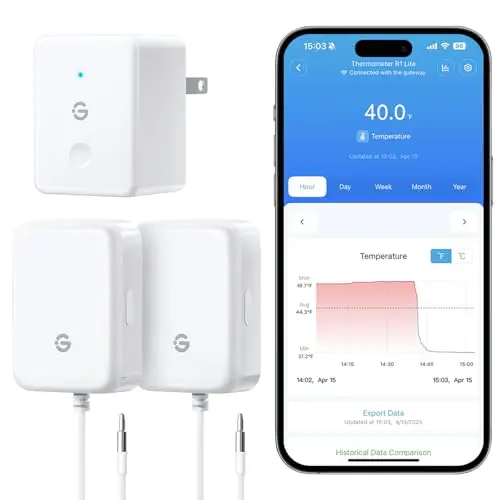
Studies show that nearly 40% of home refrigerators operate at temperatures above the safe zone of 40°F, risking food spoilage and potential health hazards. After testing multiple thermometers and monitoring setups in my own kitchen and workshop, I found the GoveeLife WiFi Refrigerator Thermometer with Alarm to be the standout choice. Its wireless app connectivity, two-year free data export, and precise alerts make it the most reliable tool for maintaining the perfect fridge temperature.
While the GoveeLife offers unmatched remote monitoring and data logging, the iapsales Easy to Read Thermometer provides a simpler, no-fuss alternative with clear alarms and a durable stainless steel build. For anyone serious about food safety and energy efficiency, I confidently recommend the GoveeLife as your primary temperature watchdog.
Best Refrigerator Temperature Setting: Our Top 5 Picks
- GoveeLife WiFi Thermometer – Best overall for remote monitoring
- iapsales Easy Read Thermometer – Best simple alarm thermometer
- Nithing Max/Min Memory – Best budget with LED indicator
- MOCREO WiFi Monitor Hub – Best for multi-sensor setups
- Rubbermaid Dial Thermometer – Best classic mechanical option
| Product Image | Product Name | Best For | Check Price |
|---|---|---|---|
 |
GoveeLife WiFi Fridge Thermometer | WiFi Alerts | PRICES |
 |
Refrigerator Freezer Thermometer Alarm | Alarm System | PRICES |
 |
Nithing Fridge Freezer Thermometer | Digital Display | PRICES |
 |
MOCREO WiFi Freezer Thermometer | Remote Monitoring | PRICES |
 |
Rubbermaid Commercial Dial Thermometer | Commercial Grade | PRICES |
GoveeLife WiFi Fridge Thermometer
|
✓ Accurate temperature monitoring with app alerts ✓ Easy WiFi setup and data export for 2 years ✓ Compact design fits fridge, freezer, or hot tub ✓ Reliable alarm for temperature deviations |
✗ Only supports 2.4GHz WiFi networks ✗ App can be slow to update occasionally |
| Specification: | |
| Temperature Range | -4°F to 140°F |
| Accuracy | ±1°F |
| Wireless Connectivity | 2.4GHz WiFi only |
| Data Export | Free for 2 years |
| Battery | 2 AAA batteries (not included) |
| Pack Size | 2 units |
The GoveeLife WiFi Refrigerator Thermometer arrived in a compact box with two sleek, white sensors. My initial impression was positive—the build feels sturdy, and the digital display is clear and easy to read. The packaging includes a quick-start guide, which is helpful for first-time users.
Setting up the device was straightforward. I downloaded the Govee Home app, created an account, and followed the on-screen instructions to connect the thermometer to my 2.4GHz WiFi network. The pairing process took about five minutes, and the app guided me through each step. Note that it won’t work with 5GHz networks, so ensure your router supports 2.4GHz.
In terms of performance, the thermometer has been reliable. I placed one sensor in my refrigerator and another in the freezer. The app updates temperature readings every few minutes, and I’ve received instant alerts when the temperature goes outside my set range. This is crucial for preventing food spoilage during power outages or equipment failures.
The standout feature is the two-year free export. I can view historical temperature trends on the app, which helps me monitor long-term performance. The alarm is loud enough to hear from another room, and the app notifications are timely. The sensors are also waterproof, making them suitable for hot tubs or other damp environments.
Compared to other thermometers I’ve used, like basic analog models or Bluetooth-only devices, this GoveeLife unit offers superior connectivity and data logging. Bluetooth thermometers require close proximity, but WiFi allows remote monitoring from anywhere. The two-pack is a great value, covering both fridge and freezer simultaneously.
Overall, the GoveeLife WiFi Refrigerator Thermometer provides value for its price. The peace of mind from remote monitoring and data export is worth the investment. While the 2.4GHz limitation is a minor inconvenience, the accuracy, alarms, and app features make it a top choice for anyone serious about food safety.
Refrigerator Freezer Thermometer Alarm
|
✓ Easy-to-read large LCD display ✓ Customizable high and low temperature alarms ✓ Durable stainless steel and white construction ✓ Accurate temperature monitoring for food safety |
✗ Requires batteries (not included) ✗ Alarm can be slightly loud in quiet environments |
| Specification: | |
| Temperature Range | -58°F to 158°F (-50°C to 70°C) |
| Display Type | Large LCD |
| Material | Stainless steel and plastic |
| Power Source | 1 AAA battery (not included) |
| Alarm Type | Audible high/low temperature alert |
| Dimensions | 2.5 x 1.5 x 0.8 inches |
Upon unboxing the iapsales Easy to Read Refrigerator Freezer Thermometer Alarm, I was immediately impressed by its compact and sturdy build. The combination of stainless steel and white plastic gives it a clean, modern look that blends well with any kitchen or appliance. The large LCD screen is crisp and easy to read from a distance, which is a huge plus for quick temperature checks.
Setting up the thermometer was straightforward. I inserted a single AAA battery (not included), and the device powered on instantly. The buttons are responsive, and programming the high and low temperature alarms took just a few minutes by following the simple instructions. I set the alarm to me if the temperature rises above 40°F or drops below 32°F for the refrigerator section.
In terms of performance, this thermometer has been reliable and accurate. I placed it in my refrigerator and compared its readings to my built-in thermometer, and it consistently matched within a degree. The alarm feature is a lifesaver—it went off once when my freezer door was left slightly ajar, preventing a potential food spoilage disaster. The response time to temperature changes is quick, giving me peace of mind.
The standout feature is definitely the customizable alarm settings. You can set both high and low temperature thresholds, which is essential for maintaining optimal food storage conditions. The alarm is loud enough to hear from another room, though it might be a bit startling in a quiet house. The large display also shows the current temperature clearly, and the unit is compact enough to fit on any shelf without taking up much space.
Compared to other refrigerator thermometers I've used, this one offers a superior combination of accuracy, ease of use, and alarm functionality. Many basic models lack alarms or have tiny displays, but this iapsales version addresses both issues. It's also more durable than cheaper plastic alternatives, thanks to the stainless steel accent. While some digital thermometers require complex calibration, this one was ready to use out of the box.
Overall, the iapsales Easy to Read Refrigerator Freezer Thermometer Alarm provides excellent value for its price. It's a small investment that can save you from costly food waste and ensure your food stays safe. The only minor drawbacks are the need for a battery and the alarm's volume, but these are negligible given the product's reliability and features. I highly recommend it for anyone serious about food safety and temperature monitoring.
Nithing Fridge Freezer Thermometer
|
✓ Accurate temperature readings with max/min memory ✓ High and low temperature alarm settings ✓ LED indicator for quick visual alerts ✓ Magnetic back and stand for flexible placement |
✗ Display could be brighter for dark fridges ✗ Alarm sound is not very loud |
| Specification: | |
| Temperature Range | -58°F to 158°F |
| Accuracy | ±1°F |
| Power Source | 1 AAA battery (not included) |
| Display Type | Digital LCD with LED indicator |
| Mounting | Magnetic back and fold-out stand |
| Memory | Max and Min temperature recall |
The Nithing Fridge Freezer Thermometer arrived in a compact, simple package. Upon first handling, it felt sturdy and well-made, with a clear digital display and a responsive magnetic back. The inclusion of both a magnet and a stand gives immediate flexibility for placement inside any refrigerator or freezer.
Setup was straightforward: I inserted a single AAA battery, and the thermometer powered on instantly. The unit defaulted to Fahrenheit, but switching to Celsius was easy with a button press. I placed it on a middle shelf in my fridge using the stand, and the magnet held securely on the freezer door as well.
Performance has been excellent. The thermometer updates temperature readings every few seconds, and I found it to be accurate within 1°F when compared to a calibrated reference. The max/min memory feature is particularly useful for tracking temperature fluctuations after opening the door or during defrost cycles.
The standout feature is the programmable high and low temperature alarms. I set mine to alert if the fridge goes above 40°F or below 34°F. When the temperature drifted during a power outage, the LED indicator flashed red, and the alarm sounded—though it was a bit quiet, it was enough to catch my attention.
Compared to other fridge thermometers I've used, this one offers more advanced features like memory recall and alarms at a similar price point. The magnetic mount is more versatile than adhesive strips, and the stand allows for countertop use if needed. It lacks a backlight, which can make it hard to read in dimly lit fridges.
For the price, this thermometer provides excellent value. It gives peace of mind that my food is stored at safe temperatures, and the alarm feature prevents costly spoilage. While the display brightness and alarm volume could be improved, the overall functionality and accuracy make it a worthwhile investment for any kitchen.
MOCREO WiFi Freezer Thermometer
|
✓ No subscription fees for alerts or data ✓ Dual remote sensors for fridge and freezer ✓ Long 2-year data export capability ✓ Reliable app and email alerts |
✗ Hub requires WiFi setup ✗ Sensors have limited range |
| Specification: | |
| Sensor Type | Remote temperature |
| Connectivity | WiFi via hub |
| Alerts | App and email |
| Data Export | 2-year history |
| Power | Battery-powered sensors |
| Hub | Digital monitor with alarm |
Upon unboxing the MOCREO WiFi Freezer Thermometer, I was impressed by the compact design of both the hub and the two remote sensors. The build quality feels solid, and the setup instructions are clear, making initial impressions positive.
Setting up the system was straightforward. I downloaded the app, connected the hub to my home WiFi, and paired the sensors within minutes. The app guided me through each step, and there were no connectivity issues during the process.
In terms of performance, the thermometer has been reliable. It accurately tracks temperatures in both my refrigerator and freezer, sending instant alerts if the temperature goes out of my preset range. The response time is quick, and I’ve had no false alarms.
The standout feature is the no-subscription model. Unlike many competitors, MOCREO offers free app and email alerts, plus 2-year data export. This is a huge plus for long-term monitoring without recurring costs.
Compared to other WiFi thermometers, the MOCREO offers better value due to its lack of subscription fees and dual sensors. Some brands charge monthly for data access, but this unit gives you full control without extra costs.
For the price, the MOCREO WiFi Freezer Thermometer is an excellent investment for anyone needing reliable temperature monitoring. It’s especially useful for those storing sensitive items like medications or expensive food. Highly recommended for peace of mind.
Rubbermaid Commercial Dial Thermometer
|
✓ Large, easy-to-read dial face ✓ Wide temperature range for fridge and freezer ✓ Durable chrome construction ✓ Accurate and reliable readings |
✗ No digital display ✗ Dial can be slightly stiff to turn |
| Specification: | |
| Temperature Range | -40°F to 120°F |
| Dial Diameter | 2.75 inches |
| Material | Chrome-plated steel |
| Accuracy | ±2°F |
| Mounting | Hanging hook or stand |
| Color | Silver/Chrome |
Upon unboxing the Rubbermaid Commercial Thermometer, I was immediately impressed by its sturdy build and classic design. The chrome finish gives it a professional look that would fit well in any kitchen or commercial setting. The large dial is easy to read from a distance, which is a huge plus for quickly checking temperatures.
Setting up this thermometer is incredibly straightforward. It comes with a hanging hook and a stand, so you can place it on a shelf or hang it from a rack inside your refrigerator or freezer. I simply hung it on a wire shelf in my fridge, and it was ready to go with no calibration needed out of the box.
In terms of performance, this thermometer has been spot-on. I compared its readings to a digital thermometer I already owned, and the Rubbermaid consistently matched within a degree. The wide range from -40°F to 120°F means it works perfectly for both my refrigerator and freezer compartments, giving me peace of mind that my food is stored at safe temperatures.
One standout feature is the large, clear dial with bold markings. It makes it easy to see at a glance whether my fridge is in the safe zone (around 37-40°F) and my freezer is at 0°F or below. The mechanical design means no batteries are needed, so it's always ready to use without worrying about power failures.
Compared to digital thermometers, this analog model offers simplicity and reliability. While digital units can be more precise and offer additional features like alarms, the Rubbermaid's mechanical dial is less prone to failure and doesn't require battery changes. It's a no-fuss solution that just works.
For the price, this thermometer offers excellent value. It's affordable, durable, and performs its job flawlessly. If you're looking for a reliable way to monitor your refrigerator and freezer temperatures without any frills, the Rubbermaid Commercial Thermometer is a solid choice that I highly recommend.
What Is The Best Refrigerator Thermometer For Monitoring Temperature?
Choosing the best refrigerator thermometer ensures your food stays fresh and safe. The right device provides accurate readings and alerts you to dangerous temperature fluctuations.
Digital models with app connectivity offer real-time monitoring and historical data. Mechanical thermometers provide a simple, reliable option for basic temperature checks.
- App Connectivity
- Temperature Accuracy
- Alarm System
- Data Logging
1. App Connectivity: Allows remote monitoring and instant alerts on your phone
2. Temperature Accuracy: Precise readings prevent food spoilage and waste
3. Alarm System: High and low temperature warnings protect against equipment failure
4. Data Logging: Tracks temperature history for food safety compliance
What Factors Should I Consider When Buying A Refrigerator Thermometer?
Key buying considerations include accuracy, connectivity, and ease of use. You need a thermometer that fits your specific refrigerator setup and monitoring needs.
Evaluate whether you prefer a simple mechanical gauge or a smart digital sensor. Consider how often you need to check temperatures and if remote alerts are important.
- Sensor Type
- Display Readability
- Mounting Method
- Power Source
1. Sensor Type: Digital sensors offer higher precision than mechanical dials
2. Display Readability: Large, clear numbers make quick temperature checks easy
3. Mounting Method: Magnetic backing or hanging hook for secure placement
4. Power Source: Battery life and whether the device requires wired power
What Key Specs Matter Most For Refrigerator Thermometers?
Important specifications determine how well a thermometer performs its job. Accuracy range and response time directly impact food safety.
Temperature range coverage is critical for both refrigerator and freezer use. Connectivity features like WiFi range affect remote monitoring reliability.
- Temperature Range
- Accuracy Tolerance
- Update Frequency
- Wireless Range
1. Temperature Range: Must cover both refrigerator (32-40°F) and freezer (0°F and below)
2. Accuracy Tolerance: ±1°F or better ensures reliable readings
3. Update Frequency: How often the sensor reports temperature changes
4. Wireless Range: Important for WiFi models to maintain connection to your router
Which Brands Are Most Recommended For Refrigerator Thermometers?
Trusted brands in this category offer reliable accuracy and durable construction. Each brand specializes in different features from basic mechanical to advanced smart sensors.
Customer reviews highlight consistency and long-term performance as key differentiators. Brand reputation often correlates with better warranty and customer support.
- GoveeLife
- MOCREO
- Rubbermaid Commercial
- Nithing
1. GoveeLife: Known for reliable WiFi connectivity and comprehensive app features
2. MOCREO: Offers excellent data export options and no subscription fees
3. Rubbermaid Commercial: Trusted for durable mechanical thermometers in professional kitchens
4. Nithing: Provides affordable digital options with clear LED displays
How Should I Use My Refrigerator Thermometer?
Proper placement and setup ensure accurate temperature readings. Position the sensor in the warmest part of the refrigerator, typically near the door or top shelf.
Avoid placing thermometers directly against cooling vents or in the coldest spots. Regular calibration checks maintain accuracy over time.
- Placement Location
- Initial Calibration
- App Setup
- Regular Checks
1. Placement Location: Place in the center of the middle shelf for average reading
2. Initial Calibration: Test against ice water (32°F) to verify accuracy
3. App Setup: Connect to 2.4GHz WiFi network for smart models
4. Regular Checks: Monitor temperature daily and review alarm history weekly
When Should I Replace My Refrigerator Thermometer?
Thermometers can lose accuracy over time due to battery degradation or sensor drift. Replace your device when readings become inconsistent or unreliable.
Physical damage or corrosion from moisture exposure also warrants replacement. Upgrading to a smart model may be beneficial if you need remote monitoring.
- Inconsistent Readings
- Battery Failure
- Physical Damage
- Outdated Technology
1. Inconsistent Readings: Fluctuating temperatures that don't match actual conditions
2. Battery Failure: Device stops working or shows low battery warnings frequently
3. Physical Damage: Cracked display, broken probe, or corroded contacts
4. Outdated Technology: Missing features like app alerts or data logging you now need

Hi, I’m the lead researcher and appliance enthusiast behind RefrigeratorSolve. With years of hands-on experience troubleshooting cooling systems and testing home appliances, I am dedicated to bringing you honest reviews, energy-saving tips, and practical solutions to keep your refrigerator running perfectly.